

When Does a Conservatory Become an Extension?
Updated: 5 days ago
If you’re planning to upgrade (or rebuild) your conservatory, it’s smart to ask this early: when does a conservatory become an extension?
In simple terms, most guides agree on the key point:
A conservatory is generally treated like an extension once it needs planning permission (because it falls outside permitted development rules).
But there’s also a practical side to this question. Many homeowners don’t just want a legal definition—they want their conservatory to feel like an extension: comfortable year-round, quieter, and more “part of the house”.

Planning permission rules
A conservatory becomes an extension when planning permission is required—either to build it or expand it. Most conservatories can be built under permitted development rights, but if you exceed those limits, the project moves into “extension” territory.
Here's some examples of when planning permission may be needed:
it covers too much of the land around the original house (e.g., more than 50%)
it’s positioned forward of certain elevations facing a road
it exceeds height limits (including eaves height rules near boundaries)
it extends too far beyond the rear wall (different limits for detached vs semi/terraced)
the home is listed, in a conservation area, or is a flat/maisonette
We also recommend checking with your Local Planning Authority (LPA) before work begins.
Permitted development limits
If the conservatory exceeds permitted development limits, you’ll need a planning application—so it’s effectively treated as an extension.
Size and height rules vary by property type and proximity to boundaries, and planning and Building Regulations can be easy to confuse - especially when homeowners assume a conservatory is always “simpler” than an extension.
Building Regulations differences
This is where many homeowners get caught out: even if planning permission isn’t required, Building Regulations may still apply depending on what you’re changing, especially if you’re converting the space to be more integrated with the main house.
A “typical” conservatory is:
over 75% glazed roof
at least 50% glazed walls…and is often separated from the main house by a door and uses a standalone heating source if it’s to be exempt from Building Regulations in certain situations.
So, if you’re removing separating doors, changing heating arrangements, or replacing the roof/walls to something more “extension-like,” the project often moves away from the classic conservatory definition and toward extension-style compliance.

Glazing requirements
The same glazing thresholds are commonly used to define a conservatory-style build:
at least 75% of the roof glazed
at least 50% of the walls glazed
If you’re planning a solid roof, warmer walls, or a more enclosed build, you’re often stepping into “extension-style” territory (even if you still call it a conservatory day-to-day).
The “10-year rule”
Checkatrade also references a “10-year rule” concept connected to changes in legislation around October 2008 and long-standing conservatories that may not meet newer requirements, but have been in continuous use without challenge for over a decade.
This is one of those areas where getting project-specific advice matters—because the safest route is to ensure your upgrade is compliant now, rather than hoping historic rules apply.
Converting a conservatory into an extension in practice
Even if your project doesn’t technically “become an extension” by planning definition, most homeowners want the outcome of an extension:
warmer in winter, cooler in summer
less glare and rain noise
a more stable “living-room” feel
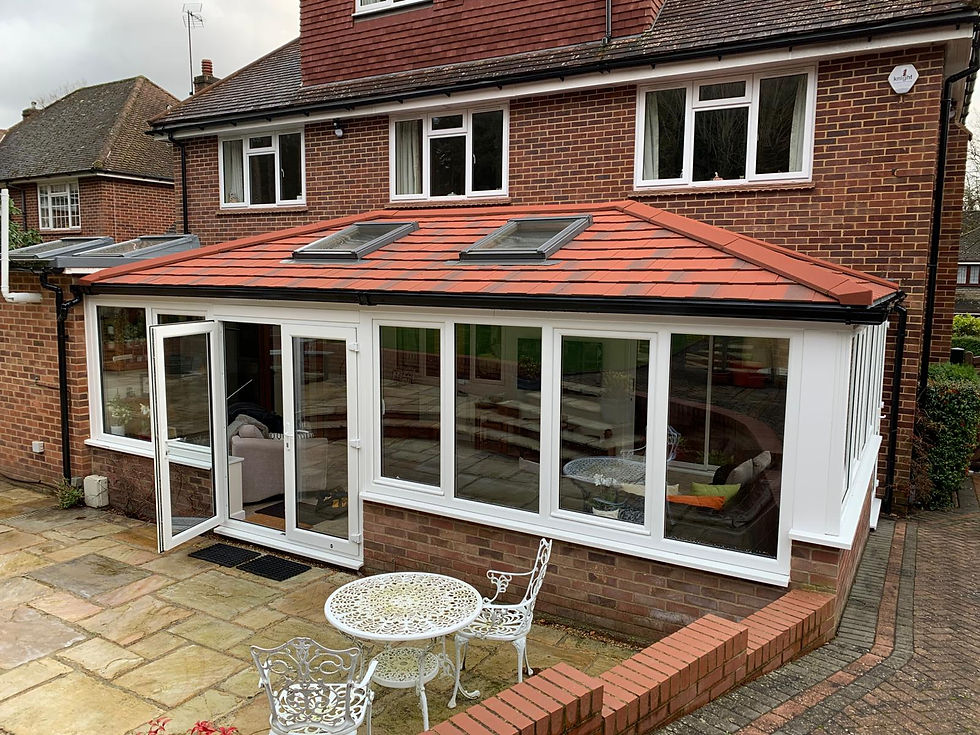
K&S Bespoke Builds focus on this exact transformation. Before we recommend anything, we assess the existing structure, insulation, how the room performs, and what you want it to become—so the upgrade is a genuine improvement, not a cosmetic patch.
Building Control and approval support
If your conservatory upgrade is moving toward an extension-style build, Building Control can feel daunting—especially for first-time homeowners.
Warmer Room (the system K&S use) highlights a dedicated in-house team to help process Building Control applications, plus independent testing/certification and checks on thermal performance and condensation risk analysis.
It also references thermal performance targets (including figures such as 0.13 W/m²K for flat roofs and as low as 0.12 W/m²K in their calculator reports, depending on build-up/spec).
Quick checklist: is your conservatory becoming an extension?
Your project is more likely to be treated as an extension if:
it needs planning permission (i.e., outside permitted development)
you’re moving away from classic conservatory glazing ratios (75% roof / 50% walls)
you’re removing separation (doors) or changing heating so it behaves like part of the main house
you’re doing a solid roof + insulated walls upgrade designed to perform like a true room


Comments